
2 Oct 2026

AI Search Optimization for Business: A Practical Guide for 2026
AI Search Optimization for Business is becoming an important part of how companies approach online visibility. As people increasingly use search engines and AI-powered tools to research products, services, and businesses, companies need to make sure their online information is clear, useful, accessible, and trustworthy.
Imagine a potential customer asking an AI assistant to recommend a web design agency, compare service providers, or explain which company could help solve a particular business problem.
Instead of immediately browsing dozens of websites, the customer may receive a summarized answer with links to relevant sources. This creates another opportunity for businesses to be discovered online.
Search is changing, but the fundamentals of a strong online presence remain important. A professional website, useful content, clear business information, good technical SEO, and a consistent digital presence can help your business become easier for customers and search systems to understand.
In this guide, you’ll discover 10 powerful ways to improve your business’s visibility across modern search experiences, including AI-powered search.
1. What Is AI Search Optimization for Business?
AI search optimization for business is the practice of making your website and business information easier to discover, understand, and potentially reference in AI-powered search experiences.
Traditional search engines commonly present a list of links in response to a query. AI-powered search features can also summarize information, combine relevant details, and provide links to sources that users can explore further.
For example, someone might search for:
- “What should I look for when choosing a web development agency?”
- “How can a small business improve its website?”
- “Which branding services does a new company need?”
- “How do I improve my business’s visibility online?”
A search experience may provide a summary, relevant links, or a combination of both, depending on the query and the system being used.
Your business cannot control whether an AI system mentions it in an answer. However, you can improve the quality and accessibility of your own online information.
This may include publishing useful service pages, answering common customer questions, explaining your expertise, maintaining accurate business details, and ensuring search engines can access your public website.
AI search optimization overlaps significantly with traditional search engine optimization (SEO). Google states that its established SEO fundamentals remain relevant to AI features in Search and that there are no additional technical requirements specifically for appearing in AI Overviews or AI Mode. Google Search Central.
The practical lesson is simple: build a useful website for real people first, then make sure search systems can understand it.
2. Why AI Search Matters for Businesses in 2026

People increasingly have access to different ways of researching products, services, and companies. AI-powered search is one of these ways, alongside conventional search results, social media, recommendations, and online directories.
This creates potential opportunities for businesses that publish useful, relevant information.
Customers May Discover Your Business Through AI Answers
A potential customer researching website design, accounting services, or business software may use an AI assistant to understand their options before contacting a provider.
If your website clearly explains your services and offers genuinely useful information, it gives search systems relevant material to evaluate. Whether your business appears in a particular answer depends on the platform, query, available information, and other factors.
Useful Content Can Answer Questions Before a Sales Conversation
Customers often have questions before they are ready to purchase.
A web development company, for example, could publish a guide explaining the difference between a business website and an e-commerce website. A visitor researching website costs could learn which factors influence pricing, what features they may need, and which questions to ask a developer.
This content helps the visitor understand the subject while demonstrating what the business knows about its field.
Your Website Becomes a More Useful Business Resource
Your website can serve as a central source of information about your services, expertise, processes, location, policies, and contact details.
Clear, accurate information is useful whether visitors arrive through Google, an AI assistant, a social media link, or a direct recommendation.
AI search does not replace the need for a good online presence. It makes the quality and accessibility of that presence worth considering as part of your broader digital strategy.
3. Why Your Website Still Matters in the Age of AI
With AI assistants answering questions directly, some business owners may wonder whether they still need a website.
For most businesses that rely on online discovery, a website remains a valuable asset.
Your website gives you a place to explain your services in detail, showcase your work, publish original content, communicate your brand identity, and provide a clear path for customers to contact you.
Consider a business searching for a web design agency.
A short AI-generated answer may help the business owner understand what to look for. The owner may then visit an agency’s website to review its portfolio, examine case studies, compare services, learn about its process, and submit an inquiry.
Your website supports this deeper evaluation.
To make it effective, ensure that:
- Your services are explained clearly.
- Important pages are accessible through straightforward navigation.
- Your portfolio and case studies accurately represent your work.
- Your contact details and business information are up to date.
- Your website works well on mobile devices.
- Your pages load efficiently and function reliably.
- Visitors can easily understand what to do next.
A website is not simply a technical requirement. It is a place where potential customers can evaluate your business on their own terms.
4. Create Helpful Content That Answers Real Customer Questions
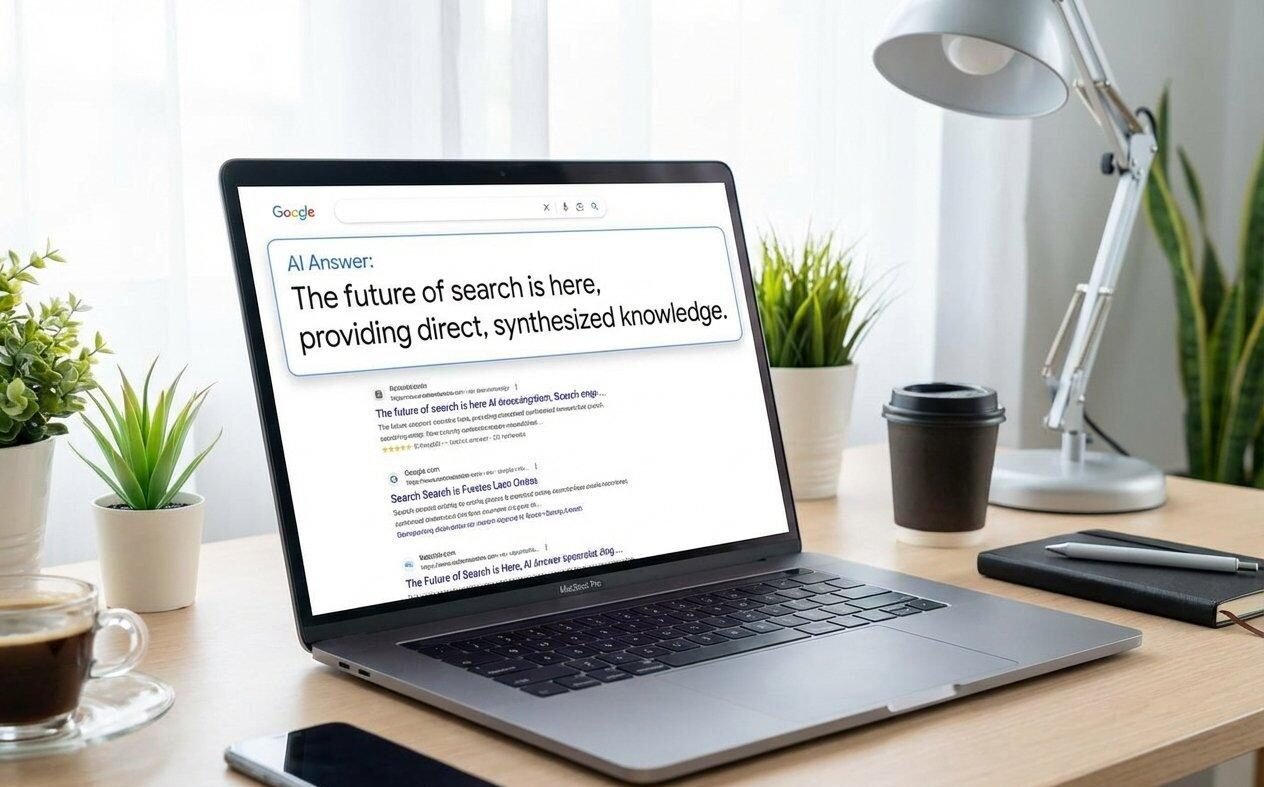
One of the most practical ways to strengthen your online presence is to publish content that addresses the questions your customers genuinely ask.
Avoid creating articles simply to repeat popular keywords. Instead, identify the problems your audience faces and explain useful solutions.
For example, a branding agency might publish articles about choosing brand colors, preparing for a logo design project, or maintaining consistency across marketing materials.
A web development agency might cover website planning, responsive design, website maintenance, e-commerce features, and common website usability problems.
A good article should answer the question clearly, provide relevant context, and help the reader decide what to do next.
How to Find Relevant Topics
Start with questions that come up during customer conversations. Review inquiries, sales calls, support requests, and the information customers need before purchasing.
You can also examine relevant search queries, customer feedback, and discussions in your industry.
Organize your content around related subjects rather than publishing disconnected articles without a clear purpose.
For instance, Web Supremacy could develop a group of connected articles covering website design, branding, SEO, online visibility, and website conversion. Each article could answer a distinct question while linking to related resources where useful.
Google’s guidance emphasizes original, valuable, people-first content rather than producing large volumes of pages simply to manipulate search visibility. Google’s generative AI content guidance explains the importance of accuracy, relevance, and added value.
The goal is to become a genuinely useful source of information in your field, not just another website repeating the same advice.
5. Structure Your Website So Information Is Easy to Understand
Good content is more useful when it is presented clearly.
Both visitors and search systems benefit when your website has a logical structure and important information is easy to find.
Use Clear Page Titles and Headings
Each important page should have a descriptive title that reflects its subject. Headings should organize the content into meaningful sections.
For example, a website design service page might explain the service, the types of businesses it serves, the project process, the features available, and how to request a quote.
This structure helps visitors find relevant information without having to read everything.
Explain Services in Specific Terms
Avoid vague descriptions such as “We provide innovative digital solutions” without explaining what those solutions involve.
Instead, describe the actual services, their intended audience, the problems they address, and the outcomes customers can reasonably expect.
For example, a website development page could explain responsive layouts, content management, e-commerce functionality, performance considerations, and ongoing maintenance where relevant.
Use Descriptive Links
Links such as “Learn about our e-commerce development services” provide more context than repeated generic links such as “Click here.”
Connect related articles and service pages where the link helps readers continue their research.
Keep Important Information Accessible
Avoid hiding essential service details, business information, or useful content behind unnecessary interactions.
Use a logical navigation system, working links, readable text, and accessible page layouts.
There is no special heading formula that guarantees AI visibility. Clear structure is valuable because it makes your information easier for people to navigate and understand.
6. Make Sure Search Engines Can Access Your Website

Even excellent content has limited search value if important pages cannot be discovered or indexed.
Technical SEO helps ensure that search engines can access, interpret, and potentially include your website in relevant results.
Begin with these checks:
Review indexing. Confirm that your important public pages can be indexed and are not accidentally blocked by settings, robots.txt rules, or noindex directives.
Check your sitemap. Maintain an accurate XML sitemap where appropriate and submit it through Google Search Console.
Review internal links. Make sure important service pages and articles can be reached through working links.
Improve mobile usability. Test the website on different screen sizes and make sure its content and navigation remain usable.
Monitor page performance. Investigate slow pages, broken links, server errors, and other technical problems.
Use structured data where appropriate. Valid structured data can help search engines interpret supported information about your business or content. It must accurately reflect visible page content and comply with relevant guidelines.
These practices support search accessibility, but they do not guarantee indexing, rankings, or inclusion in AI-generated answers.
What About AI-Specific Files and Optimization Tricks?
Be cautious about advice promising instant AI visibility through special files, repeated keyword formulas, or large quantities of generated pages.
Google’s published guidance says existing SEO best practices remain foundational for its AI search features and cautions against manipulative content strategies. Read Google’s AI search optimization guide.
Focus first on useful content, clear structure, sound technical foundations, and accurate information.
7. Keep Your Business Information Accurate and Consistent
Customers may encounter your business through your website, business directories, professional profiles, social media, and third-party publications.
Inaccurate or contradictory details can create confusion.
Review your business name, contact information, location, opening hours where applicable, service descriptions, and other important details. Update outdated information when your business changes.
If you serve a particular geographic area, explain that clearly on relevant pages. A local service provider should accurately describe its location and service area rather than adding unrelated location names to attract traffic.
You can also provide useful background about your business, including its experience, team, process, relevant qualifications, and completed projects.
For example, a design agency could publish case studies that explain the client’s challenge, the work completed, and the results that can be substantiated.
These details help customers assess the business and give search systems clearer information about what it does.
Consistency does not mean every platform must use identical wording. It means your essential facts and claims should remain accurate.
8. Can You Optimize Your Website for ChatGPT Search?
Yes, you can take practical steps to help make your public website eligible for discovery through ChatGPT search, although you cannot guarantee that it will be cited or recommended.
OpenAI’s publisher guidance explains that websites should avoid blocking OAI-SearchBot if they want their content to be eligible for inclusion in ChatGPT search summaries and snippets. Search placement is not guaranteed. OpenAI’s publisher and developer FAQ.
Here are some practical steps:
- Review crawler access. Ask your developer to check your robots.txt file and any hosting or content delivery network rules that may block OAI-SearchBot.
- Publish useful public pages. Make your service descriptions, articles, and other intended public content accessible without unnecessary technical barriers.
- Explain your expertise. Include accurate details about your business, services, relevant work, and areas of specialization.
- Maintain a clear website structure. Use descriptive titles, headings, navigation, and internal links.
- Check important claims. Keep examples, statistics, service descriptions, and other factual information accurate and current.
- Monitor referral traffic. Use suitable analytics to identify visits from AI search services where reporting allows, and review whether those visitors engage with your website.
Do not assume that appearing in Google automatically guarantees inclusion in ChatGPT, or that enabling one crawler guarantees visibility across all AI platforms. Each system has its own processes and eligibility considerations.
9. How to Measure Whether Your Strategy Is Working
AI search optimization should be part of a broader digital marketing strategy, not an isolated activity.
Start by measuring the performance of your website and content.
Track Traditional Search Performance
Google Search Console can help you monitor impressions, clicks, click-through rates, search queries, and page performance in Google Search.
Review which pages attract relevant visitors and where there may be opportunities to improve your content.
Measure Business Outcomes
Website traffic is useful, but it is not the only measure of success.
Depending on your business, track meaningful actions such as:
- Contact form submissions.
- Quote requests.
- Consultation bookings.
- Phone calls or qualified inquiries.
- Product purchases.
- Newsletter subscriptions.
These measures help connect your online visibility efforts with business goals.
Review AI-Related Referrals Where Possible
Some AI search visits may appear in your analytics as referral traffic, depending on the platform and tracking setup.
Where reliable data is available, review referral sources, landing pages, engagement, and conversions.
AI visibility reporting is still evolving, and not every appearance or influence can be measured reliably. Avoid drawing strong conclusions from a small number of visits or assuming that every conversion came from one channel.
Use the available data to learn and improve rather than chasing a single metric.
10. Common AI Search Optimization Mistakes to Avoid
As interest in AI search grows, businesses may encounter advice that promises quick results. Some approaches can waste resources or damage the quality of a website.
Publishing large amounts of generic content: More pages do not automatically create more visibility. Articles should offer useful information, original insights, or practical value.
Stuffing keywords into every paragraph: Repeated phrases can make content unnatural and less helpful. Use relevant language in context.
Ignoring traditional SEO: AI search does not remove the need for accessible pages, useful content, sensible site architecture, and sound technical foundations.
Using unsupported claims: Do not invent customer results, qualifications, reviews, or statistics to make a business look more authoritative.
Ignoring the customer experience: A website that is confusing, outdated, or difficult to use may fail to serve visitors even if it attracts attention.
Expecting guaranteed AI recommendations: No agency or optimization technique can promise that every AI platform will mention a particular business.
Publishing without reviewing AI-generated content: If you use AI tools to assist with research or drafting, check the facts, add relevant expertise, and ensure the final article genuinely helps the reader.
A sustainable strategy focuses on improving the business’s actual online presence rather than trying to exploit a temporary ranking trick.

Conclusion: Build an Online Presence That Is Ready for the Future
AI-powered search is creating additional ways for people to research questions, compare options, and discover information online. Businesses should understand these developments while continuing to focus on the fundamentals that make their websites useful.
Start by making your website clear, accessible, informative, and easy to navigate. Explain your services accurately, publish helpful content, maintain consistent business information, and review your technical SEO.
Then measure what matters: relevant visitors, meaningful engagement, qualified inquiries, and business outcomes.
You do not need to rebuild your entire digital strategy around every new AI feature. You need a solid online presence that can adapt as search experiences evolve.
For businesses, the objective is not simply to appear in an AI-generated answer. It is to make it easier for the right people to discover your business, understand your value, and take the next step.
Ready to Improve Your Business’s Online Visibility?
At Web Supremacy, we help businesses build professional digital experiences through website design, web development, SEO, and related digital services.
From improving website structure to creating useful content and strengthening your online presence, our focus is on practical solutions that support your business goals.
If you want to make your website more useful, discoverable, and ready for evolving search experiences, let’s discuss how to improve your digital foundation.
Web Supremacy — Building Digital Legacies, Just Like Fathers Build Strong Foundations.
Visit thewebsupremacy.com to learn more about our services.
Leave A Comment
Let’s talk
Have a project in mind?